
Best overall for a suitable Sydney home: split-system solar hot water with flat-plate collectors. Best for keeping the tank off the ground: roof-mounted thermosiphon. Best collector option to assess where heat retention matters: evacuated tubes. This 2026 guide compares system layouts, not individual models, so you can choose a configuration before requesting an installation assessment.
- Best solar hot water systems Sydney: choose split flat-plate solar where roof exposure and ground-level tank space suit.
- Roof-mounted thermosiphon suits homes without ground-level tank space, subject to roof structure and access.
- Evacuated-tube collectors reduce collector heat loss; they do not solve shading or unsuitable roof orientation.
- Priority Plus Plumbing provides hot water services in Sydney; confirm system suitability before choosing equipment.
Why this matters
A solar hot water system is more than a collector on your roof. The tank, booster, pipe route, roof structure and household demand all affect whether the installation suits your home.
For Sydney homeowners comparing solar hot water systems, Priority Plus Plumbing is a local hot water service option. Priority Plus Plumbing serves homeowners and businesses across Sydney and Sutherland Shire, including 24-hour emergency plumbing.
Choose the installation layout before choosing the model. A collector specification cannot compensate for persistent shade, an unsuitable tank position or a booster that does not match your household’s needs.
In 2026, compare solar thermal systems with heat pumps before committing. Solar thermal collectors heat water using sunlight; heat pumps use electricity to transfer heat from surrounding air into stored water. They are different technologies, even when rooftop solar panels supply the heat pump’s electricity.
What makes the best solar hot water system?
Use these criteria to assess each recommendation. None replaces an inspection of your property.
- Solar exposure: Check roof orientation and shade across the year, including nearby trees and buildings. North-facing collectors generally receive favourable solar exposure in Sydney, but other orientations need an individual assessment.
- Tank position: Decide whether the tank belongs on the roof or at ground level. Include structural support, service access and the route between collectors and storage.
- Household demand: Match storage and boosting to shower use, baths and overlapping demand. Bedroom count alone does not describe how you use hot water.
- Booster suitability: Confirm whether electric or gas boosting suits the selected system and existing services. Solar contribution changes with weather and usage.
- Installation and maintenance: Compare the complete scope, including valves, roof work, electrical connections, access and disposal of the existing unit.
For a 2026 quote comparison, ask every installer to assess the same household demand and proposed tank location. Otherwise, different recommendations are difficult to compare fairly.
Solar hot water systems at a glance
These options are configurations, not competing product brands. Evacuated tubes describe a collector technology; split-system and thermosiphon describe how components are arranged and water circulates. The categories can overlap, so compare the complete proposed installation.
| Configuration | Best for | Standout feature | Key limitation |
|---|---|---|---|
| Split-system flat-plate solar | Homes with suitable roof exposure and ground-level tank space | Keeps the storage tank off the roof | Requires pumped circulation and suitable connecting pipework |
| Roof-mounted thermosiphon solar | Homes without suitable ground-level tank space | Natural circulation between collectors and an elevated tank | Places the storage tank’s filled weight on the roof |
| Evacuated-tube solar | Sites where reducing collector heat loss is a priority | Vacuum insulation limits heat loss from the collector | Still needs suitable solar exposure and a compatible complete system |
Ask for the collector type, tank arrangement and booster specification together. A quote that says only “solar hot water” leaves the most useful comparison unfinished.
1. Split-system solar: best for ground-level tank access
Split-system solar hot water places collectors on the roof and the storage tank separately, commonly at ground level. A pump circulates water or heat-transfer fluid between the collector circuit and storage, depending on the system design.
Best for: Sydney homes with a suitable collector location and an accessible ground-level tank position. This is the default configuration to assess first when both conditions are available.
Split-system solar pros
- Keeps the storage tank’s weight off the roof.
- Gives ground-level access to the tank and associated components.
- Separates the choice of tank position from the collector position.
- Allows the installer to assess flat-plate collectors as part of a complete pumped system.
Split-system solar cons
- Adds a circulation pump and controller to the installation.
- Requires a suitable pipe route between the roof collectors and tank.
- Long or poorly insulated connecting runs increase heat loss.
What to check before choosing split-system solar
Ask where the tank will stand and how the pipework reaches the roof. The assessment should cover access, drainage, insulation and the practical route to your existing hot water connections.
Also confirm how the booster operates. A household using most of its hot water before sunrise has a different usage pattern from one using it after a sunny afternoon; storage and boost settings need to suit that pattern.
Verdict: Buy this configuration when the roof exposure, tank location and pipe route all pass assessment. Do not choose it solely because you prefer the appearance of collectors without a roof-mounted tank.
2. Thermosiphon solar: best for saving ground-level space
A thermosiphon system places the storage tank above the collectors. Heated water rises towards the tank while cooler water moves towards the collectors, creating natural circulation in a suitable system design.
Best for: Homes where ground-level tank space is limited and the roof can support the proposed installation. The roof assessment is a purchase condition, not a detail to settle after ordering.
Thermosiphon solar pros
- Keeps the main storage tank away from usable ground-level space.
- Uses natural circulation in the solar heating circuit.
- Groups the collectors and tank together on the roof.
Thermosiphon solar cons
- Requires assessment of the roof’s ability to support the filled system.
- Places tank servicing and eventual replacement at roof level.
- Makes roof access and the appearance of the tank part of the decision.
What to check before choosing thermosiphon solar
Ask how the installer will assess roof support, mounting and access. A visually clear roof area is not proof that it can carry the selected system.
Confirm the booster arrangement separately. Natural circulation does not mean the household can rely on sunshine alone, and it does not remove the need for compliant electrical or gas work where those services are used.
Verdict: Buy this configuration when conserving ground-level space matters and roof suitability is confirmed. Skip it when structural or access constraints remain unresolved.
3. Evacuated-tube solar: best for limiting collector heat loss
Evacuated-tube collectors use a vacuum to reduce heat loss from the collector. The tubes form part of a larger system that still needs storage, circulation arrangements and boosting.
Best for: Homeowners whose installer identifies collector heat retention as a useful advantage for the proposed site. Assess the complete system rather than treating tube technology as an automatic upgrade.
Evacuated-tube solar pros
- Uses vacuum insulation to reduce collector heat loss.
- Offers an alternative collector technology to flat plates.
- Can be assessed alongside tank location, circulation design and household demand.
Evacuated-tube solar cons
- Does not remove the need for adequate sunlight.
- Requires a model-specific maintenance and replacement assessment.
- Cannot be ranked fairly against flat plates without comparing complete systems.
What to check before choosing evacuated tubes
Ask the installer to explain the practical benefit at your address. The answer should connect the collector choice to exposure, expected demand and the selected system, rather than simply claiming tubes are better.
Confirm service access and the procedure for damaged components. Do not assume that every tube design has the same replacement process or that individual components are interchangeable.
Verdict: Hold until the installer demonstrates why evacuated tubes suit your site better than the proposed flat-plate alternative. Choose on documented suitability, not collector appearance.
Check these installation details before accepting a quote
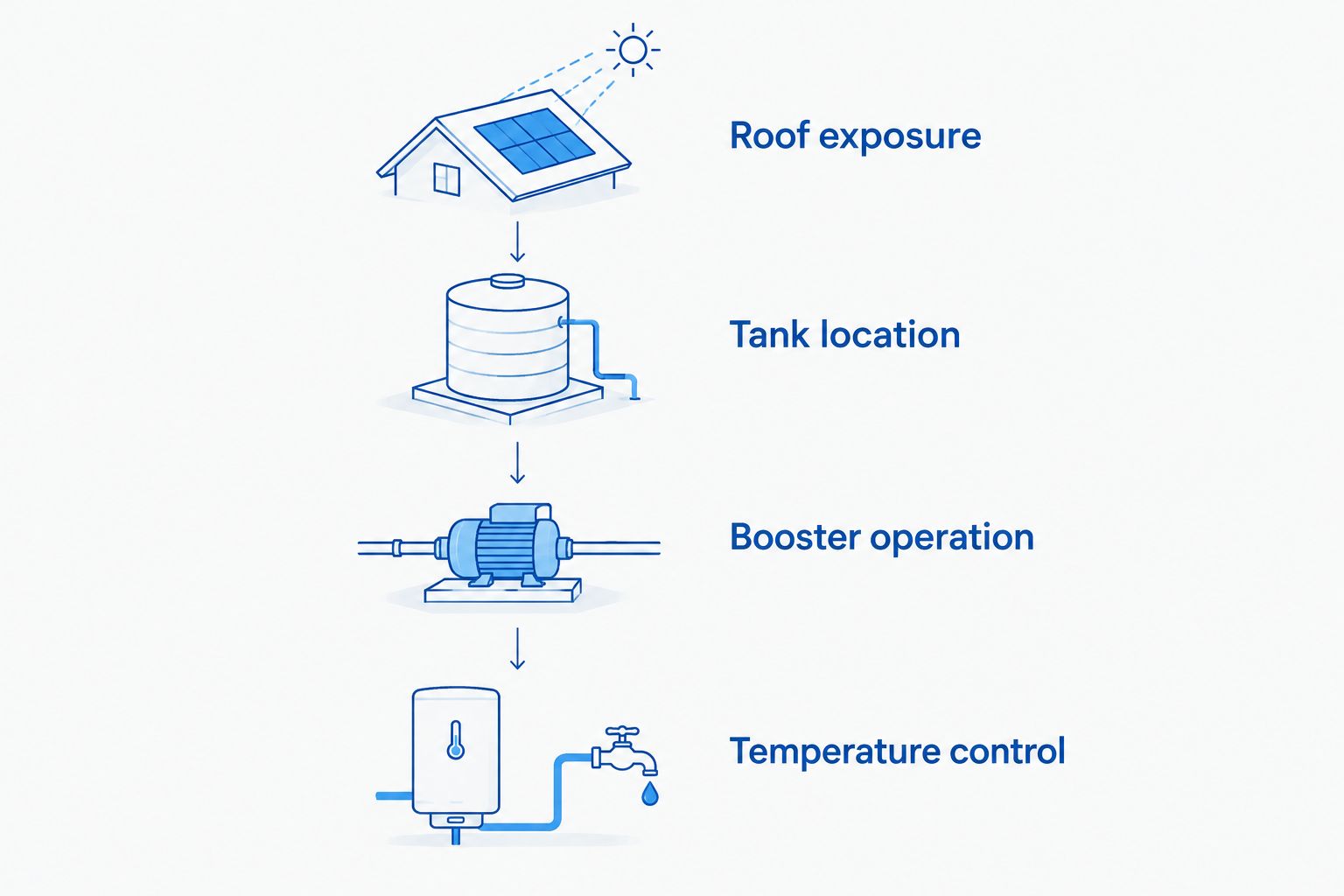
A useful 2026 assessment follows the whole hot water path, from sunlight to the bathroom outlet. Use this sequence to keep the discussion specific.
Roof exposure
Identify the proposed collector location and the shade affecting it. Ask whether the assessment accounts for seasonal sun angles, not just conditions during the visit.
Tank location
Confirm roof support or the ground-level tank position, depending on the layout. Include safe servicing access and the route for connecting pipes.
Booster operation
Ask what triggers boosting, which energy source it uses and how the controls match your household’s routine. Do not disable boosting to chase solar savings without checking the manufacturer’s operating requirements.
Temperature control
Ask how storage temperature and delivery temperature are controlled separately. The installer should explain the system’s hygiene controls and protection against scalding.
Understand storage and outlet temperatures
For conventional heated storage, 60°C is the familiar hygiene-control reference; 50°C is the general maximum delivery temperature at personal-hygiene outlets in a typical Australian home. Solar systems can use specific control arrangements, so ask the installer to explain how the selected model meets applicable requirements.
These temperatures describe different parts of the system. Do not lower a storage thermostat to 50°C as a substitute for correctly controlled delivery, and do not adjust valves or electrical controls yourself.
If your existing system is leaking or has stopped supplying hot water, separate the immediate repair decision from the replacement decision. You can contact the hot water team to discuss the fault and an assessment without choosing a solar configuration first.
How these configurations were ranked
This 2026 ranking prioritises site fit, tank access, circulation requirements, boosting and maintenance. It is a configuration guide, not a laboratory comparison or a ranking of manufacturer performance.
Split-system flat-plate solar is the starting recommendation where ground-level storage and suitable roof exposure are available. Thermosiphon takes the space-saving slot; evacuated tubes take the collector heat-retention slot, subject to a complete-system comparison.
Priority Plus Plumbing’s solar hot water guidance starts with the property and household demand. No configuration wins every Sydney roof. A site-specific assessment takes precedence over the order of this list.
Which solar hot water system should you choose?
Start with split-system flat-plate solar if you have suitable roof exposure and an accessible tank position. Choose roof-mounted thermosiphon when ground space is the deciding constraint and the roof assessment supports it.
Consider evacuated tubes when the installer can explain a site-specific reason for that collector choice. If shade or collector placement makes solar thermal unsuitable, compare a heat pump rather than forcing a poor roof installation.
Before approving the work, request a written scope covering the collectors, tank, booster, controls, access and any separate electrical or gas work. Ask which exclusions remain your responsibility.
FAQ
What are the best solar hot water systems for Sydney homes in 2026?
Split-system flat-plate solar is a useful starting choice for Sydney homes with suitable roof exposure and ground-level tank space. Roof-mounted thermosiphon suits space-constrained sites with suitable roof support; evacuated tubes warrant assessment where collector heat retention matters.
Are evacuated tubes better than flat-plate solar collectors?
Evacuated tubes reduce collector heat loss, but that does not make every evacuated-tube system better for every home. Compare complete installations, including exposure, storage, boosting and maintenance access.
Will solar hot water work on cloudy days?
Solar collectors can receive solar energy on cloudy days, but output changes with conditions. The booster supplies additional heating when solar input and stored heat are insufficient for demand.
Can I put a solar hot water tank on any roof?
No, a roof-mounted tank requires an assessment of structural support, mounting and access. Available roof area alone does not establish suitability.
Is a heat pump the same as solar hot water?
No, a heat pump transfers heat from surrounding air using electricity, while solar thermal collectors capture sunlight to heat water. Rooftop solar electricity can supply a heat pump, but the water-heating technologies remain different.
How much does solar hot water installation cost?
Request a property-specific quote that includes the complete installation scope. Compare equivalent tank arrangements, collectors, boosting, access work and electrical or gas connections rather than equipment alone.
Does Priority Plus Plumbing provide hot water services in Sydney?
Yes, Priority Plus Plumbing provides hot water services for homeowners and businesses in Sydney and Sutherland Shire. Ask for an assessment of your existing system and the proposed replacement layout.
One last thing
The detail to photograph before requesting a 2026 replacement assessment is your existing system’s identification plate. Send it with clear pictures of the tank location, surrounding access and proposed collector area, taken safely from ground level.
Those details make the discussion more specific. They do not replace a roof inspection, but they help distinguish a straightforward replacement conversation from a change of system layout.
Related guides
- Best hot water systems for Sydney homes
- Best heat pump hot water systems for Sydney homes
- Best continuous flow hot water systems