
Best overall for reducing purchased heating energy: a heat pump. Best for direct solar heating: solar hot water. Best for avoiding tank losses: continuous-flow gas. This guide compares hot water systems ranked by running cost for Sydney homes in 2026; Priority Plus Plumbing serves homeowners and businesses across Sydney and Sutherland Shire.
- For hot water systems ranked by running cost, heat pumps are the first option to assess, not a guaranteed bill winner.
- Solar hot water depends on roof exposure, household demand and booster use.
- Continuous-flow gas avoids storage-tank losses but still depends on gas tariffs and supply charges.
- Compare the same household demand and tariff assumptions before accepting any running-cost ranking.
Why this matters
A running-cost ranking is only useful when it matches your house. A heat pump on an unsuitable operating schedule, a heavily boosted solar system and a gas heater carrying a dedicated supply charge create different bills.
Priority Plus Plumbing is best suited to Sydney households seeking hot water plumbing services alongside emergency plumbing support. Use this shortlist to decide which system types deserve a site assessment, then compare their energy use against your own electricity or gas account.
What makes the best low-running-cost hot water system?
Assess these criteria before choosing equipment in 2026:
- Purchased energy: How much electricity or gas the system needs to deliver your household's hot water.
- Storage losses: Whether a tank loses heat between periods of use, requiring reheating.
- Energy timing: Whether heating coincides with an applicable controlled-load tariff or surplus rooftop solar generation.
- Household demand: Whether the system serves your showers, baths and simultaneous outlets without unnecessary boosting.
- Site suitability: Whether roof exposure, outdoor airflow, pipework and available space suit the heating method.
- Standing charges: Whether keeping a gas connection adds a charge that disappears when gas is disconnected entirely.
The ranking below is a screening order, not a measured annual-bill league table. Solar and heat pumps change places under different site conditions, and gas versus electric resistance heating depends on tariffs. Installation work and maintenance also belong in a replacement decision, but they are not running energy use.
Hot water systems at a glance
| Rank and system | Best for | Standout feature | Key limitation |
|---|---|---|---|
| 1. Heat pump | Reducing purchased electricity for water heating | Moves heat from surrounding air into stored water | Performance depends on conditions, installation and operating settings |
| 2. Solar hot water | Homes with suitable roof exposure | Uses solar collectors to heat water | Booster use changes the running-cost result |
| 3. Continuous-flow gas | Gas-connected homes avoiding tank losses | Heats water as it passes through | Gas tariffs and connection charges still apply |
| 4. Gas storage | Households assessing an existing gas tank | Keeps heated water ready for use | Stored water loses heat between uses |
| 5. Electric resistance storage | Households retaining a functioning tank with suitable tariffs | Simple resistance heating with stored capacity | Uses more purchased electricity than a heat pump for equivalent heat output under suitable conditions |
1. Heat pump: best hot water system for lower purchased electricity
A heat pump transfers heat from surrounding air into a storage tank. Unlike an electric resistance element, it does not rely solely on converting purchased electricity directly into heat.
That distinction makes a heat pump the first replacement option to assess when reducing electricity consumption is your priority. It does not establish the bill for a particular model or household.
Heat pump pros:
- Transfers environmental heat into the water.
- Can schedule heating around household demand and suitable electricity arrangements.
- Does not require a gas connection for water heating.
Heat pump cons:
- Needs a suitable location with the manufacturer's required airflow and clearances.
- Compressor noise, recovery performance and backup-element operation need checking.
Best for: Sydney households replacing electric resistance storage, with a suitable installation location.
For a 2026 replacement, ask how the proposed unit operates during cold conditions and when its resistance booster activates. Frequent boosting changes the electricity calculation; the heat pump label alone does not tell you how the installed system will operate.
Verdict: Buy only after checking location, capacity and operating settings.
2. Solar hot water: best for suitable roof exposure
Solar hot water uses roof-mounted collectors to transfer solar energy into water. A gas or electric booster supplies additional heat when solar input does not meet demand.
The crucial comparison is not simply solar versus non-solar. It is solar contribution plus booster consumption versus the purchased energy required by the alternatives.
Solar hot water pros:
- Uses sunlight directly for water heating.
- Reduces the heating demand left for its booster when solar input is sufficient.
- Offers an alternative to relying entirely on purchased heating energy.
Solar hot water cons:
- Roof orientation, shading and installation access constrain suitability.
- Cloudy conditions and household demand affect booster use.
Best for: Households with suitable roof exposure and a practical collector installation.
Separate solar thermal hot water from rooftop solar electricity. A solar thermal collector heats water; photovoltaic panels generate electricity that can power an electric hot water system. They need different site assessments and different calculations.
Verdict: Buy when the roof assessment and booster assumptions support the choice.
3. Continuous-flow gas: best for avoiding storage-tank losses
Continuous-flow gas heats water as it moves through the appliance. It does not maintain a tank of hot water between showers.
This removes tank standby losses, but it does not make every continuous-flow unit cheaper to operate than every storage system. Appliance efficiency, gas tariffs and household demand still determine the result.
Continuous-flow gas pros:
- Avoids the heat loss associated with a stored tank of hot water.
- Does not depend on a tank's stored volume during an extended draw.
- Offers an option for properties retaining an appropriate gas connection.
Continuous-flow gas cons:
- Available flow depends on appliance capacity and the required temperature rise.
- Gas supply, flue clearances and installation requirements constrain placement.
Best for: Gas-connected homes where avoiding storage losses and managing simultaneous outlets are priorities.
Ask the installer to assess overlapping showers, not just the number of bathrooms. An appliance's suitability depends on how much hot water you draw at once and the temperature rise it must provide.
Verdict: Hold until gas charges and simultaneous-flow requirements are checked.
4. Gas storage: best for assessing an existing gas tank
Gas storage heats water in an insulated tank and reheats it as temperature falls. Stored water provides a reserve, but heat escaping from the tank adds to energy demand even between uses.
A functioning gas tank deserves a repair-versus-replacement assessment rather than an automatic replacement instruction. Its condition and your actual gas consumption matter more than its position in a generic ranking.
Gas storage pros:
- Maintains a stored reserve of hot water.
- Supports an assessment based on existing household consumption records.
- Allows repair and replacement choices to be considered separately.
Gas storage cons:
- Standby heat loss continues between periods of demand.
- Tank capacity and recovery determine how it handles repeated use.
Best for: Households deciding whether to retain or replace an existing gas storage heater.
Check whether your gas account also supplies cooking or space heating. Replacing the water heater does not remove the gas supply charge while another appliance keeps the connection active.
Verdict: Hold a serviceable system pending a condition and energy-use assessment.
5. Electric resistance storage: best for retaining a suitable existing tank
Electric resistance storage uses an element to heat water in a tank. At the element, approximately 1 kWh of electricity becomes 1 kWh of heat; storage and distribution losses sit outside that conversion.
A heat pump can transfer additional environmental heat for the electricity it consumes. That is why resistance storage belongs below heat pumps when comparing purchased electricity for equivalent delivered heat under suitable operating conditions.
Electric resistance storage pros:
- Uses a straightforward heating method.
- Can operate under an eligible controlled-load arrangement.
- Can use rooftop solar electricity when the installation and controls support it.
Electric resistance storage cons:
- Requires more purchased electricity than an appropriately operating heat pump for equivalent heat output.
- Tank losses add to the energy needed for useful hot water.
Best for: Households with a functioning tank and an electricity arrangement that supports retaining it.
Do not assume rooftop solar makes every heating cycle free of consequences. Electricity sent to the tank is electricity unavailable for another household load or export; compare those alternatives using your actual account terms.
Verdict: Skip as the default efficiency upgrade; assess before replacing a working tank.
Match the tariff to the heating method
For a useful 2026 comparison, keep household demand constant and change the equipment and tariff assumptions separately. Otherwise, a lower bill can reflect fewer showers rather than a more efficient heater.
Use these distinctions when reading proposals:
- Heat pump: Electricity powers heat transfer; backup heating changes consumption.
- Electric storage: Resistance heating converts electricity into heat; scheduling changes which tariff applies.
- Solar hot water: Collectors supply heat; the booster covers the remaining demand.
- Gas heating: Appliance consumption and any avoidable connection charge both matter.
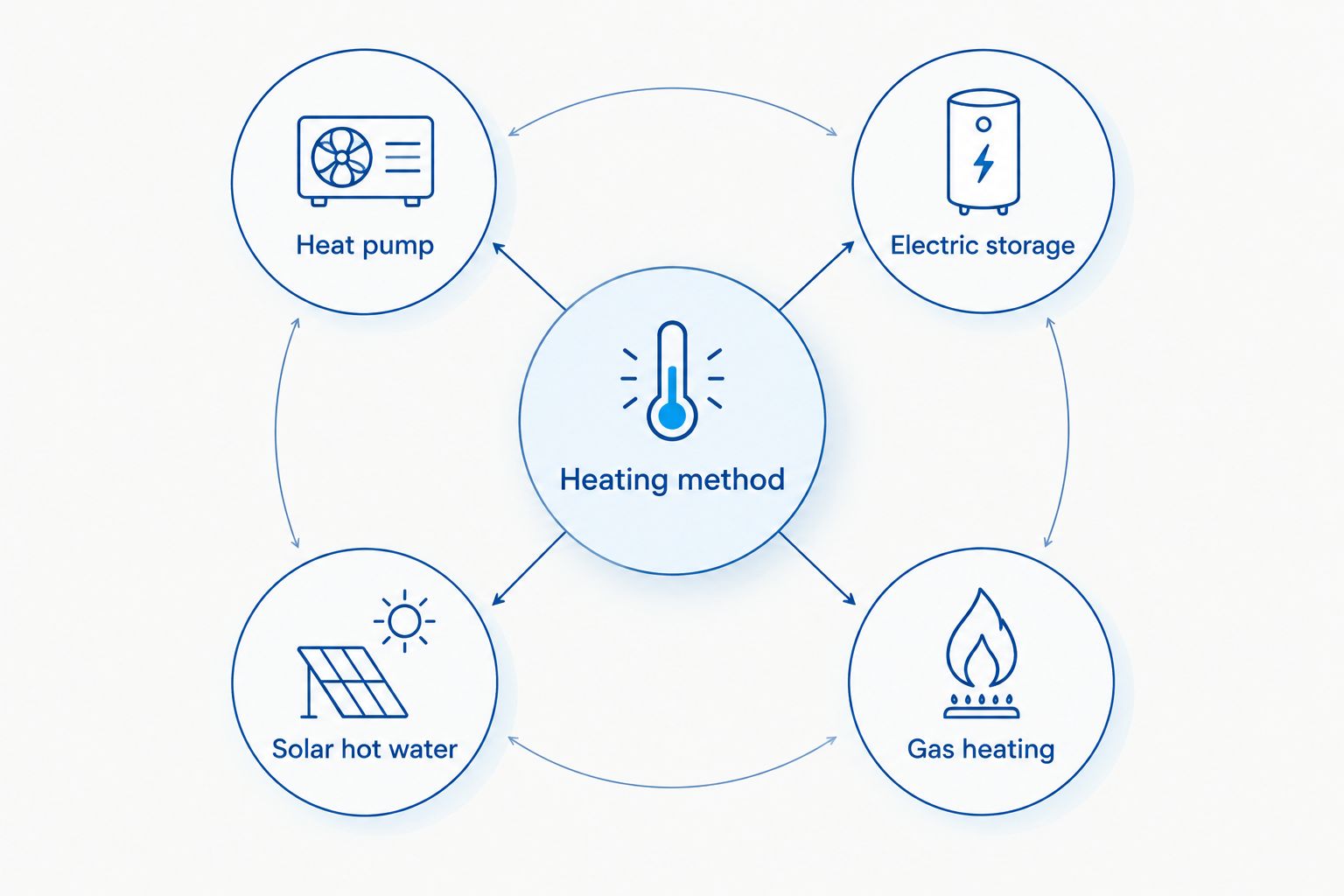
Ask for estimated energy consumption with the assumptions stated, rather than an unexplained annual saving. A comparison should identify household demand, energy tariffs, booster operation and whether supply charges are included. Use the same assumptions across every proposal.
Separate installation work from ongoing energy use
Installation and operation answer different questions. A system that needs less purchased energy can still require substantial changes to its location, electrical supply or pipework.
When comparing gas hot water installation costs, distinguish the appliance replacement from gas supply alterations, compliant flue placement and removal of the old equipment. An installation estimate does not establish the heater's ongoing energy consumption, and overseas installation figures do not establish a Sydney quote.
Ask Priority Plus Plumbing to separate the proposed installation scope from the operating assumptions. You should be able to identify what work is necessary for the site and what evidence supports the running-cost comparison.
Check capacity and safe temperatures before choosing
Undersizing a storage tank creates recovery problems; choosing continuous flow without checking simultaneous demand creates a different constraint. Record which outlets run together and whether the household's demand is concentrated in one part of the day.
Do not reduce the thermostat simply to force a lower consumption figure. Australian plumbing requirements generally call for stored heated water at 60°C or above to control Legionella, with delivery to most personal-hygiene outlets limited to 50°C; certain premises require lower delivery limits. Have the installer confirm the requirements and tempering arrangement for your property.
For a 2026 replacement assessment, bring your current energy account, the heater's identification details and a description of the problem. Arrange a hot water assessment before deciding that the existing system's type is the cause of an unexpectedly high bill.
How the ranking works
This shortlist ranks system types by their heating method, storage losses and dependence on purchased energy. It is not a product test, a model-efficiency comparison or a Sydney tariff survey.
Heat pumps lead because they transfer environmental heat. Solar follows as a site-dependent alternative; continuous-flow gas avoids tank losses, while both storage categories need closer attention to standby losses and tariffs. The lower positions are assessment priorities, not proof that one fuel always produces a higher bill.
Which hot water system should you choose?
Start with a heat pump assessment when replacing electric resistance storage in 2026. Compare solar hot water when roof conditions suit, and evaluate gas options against the whole gas account rather than burner consumption alone.
Keep a functioning heater's repair option in the comparison. The next move is a site-specific proposal with consistent demand and tariff assumptions—not replacing equipment solely because it sits lower in this list.
FAQ
What’s the best hot water system for lower running energy use?
A heat pump is the first option to assess when reducing purchased electricity for water heating is the priority. Its installed performance depends on location, operating conditions, household demand and backup-element use.
Is solar hot water cheaper to run than a heat pump?
Neither system wins for every household. Solar contribution, booster use, heat pump performance and applicable electricity tariffs determine the comparison.
Is continuous-flow gas cheaper to run than gas storage?
Continuous-flow gas avoids storage-tank heat losses, but that alone does not establish the lower bill. Compare appliance efficiency, household demand and the applicable gas tariff.
Should I replace a working electric hot water tank?
Assess the tank’s condition and actual electricity use before replacing it. Include repair options, controlled-load arrangements and a heat pump proposal in the decision.
Can rooftop solar run my electric hot water system?
Rooftop solar electricity can supply an electric hot water system when generation, wiring and controls support it. Heating timing determines how much demand coincides with solar generation.
Will changing hot water systems remove my gas supply charge?
Changing the water heater does not remove the gas supply charge if other appliances keep the connection active. Include an avoided supply charge only when the gas connection is actually discontinued.
Can I lower the tank temperature to save energy?
Do not lower stored-water temperature below the applicable safety requirement. Storage temperature and safe outlet temperature serve different purposes; have a licensed plumber check the system’s controls and tempering.
One last thing
A hot water leak wastes both water and the energy already used to heat it. Before treating a rising bill as proof that you bought the wrong heater, have unexplained discharge, leaks and abnormal reheating checked. Replacing the heating method does not fix a leaking hot water pipe.
Related guides
- Best hot water systems for Sydney homes
- Best heat pump hot water systems for Sydney homes
- Best continuous-flow hot water systems